Mary Zicafoose: Weaving in Code

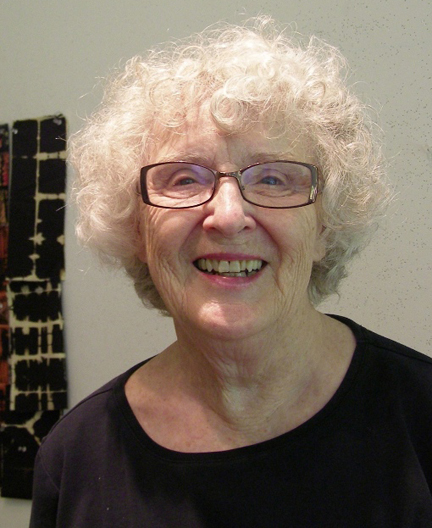
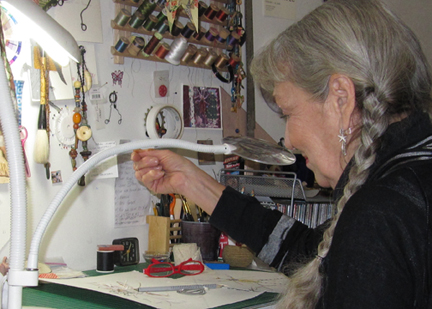
Mary Zicafoose with a fraction of the wrapped ikat sections required for a single tapestry.

TSGNY: Which textile techniques do you incorporate in your work?

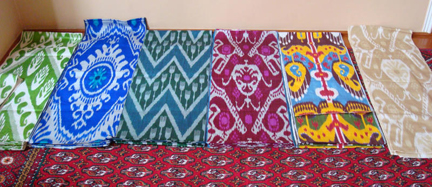
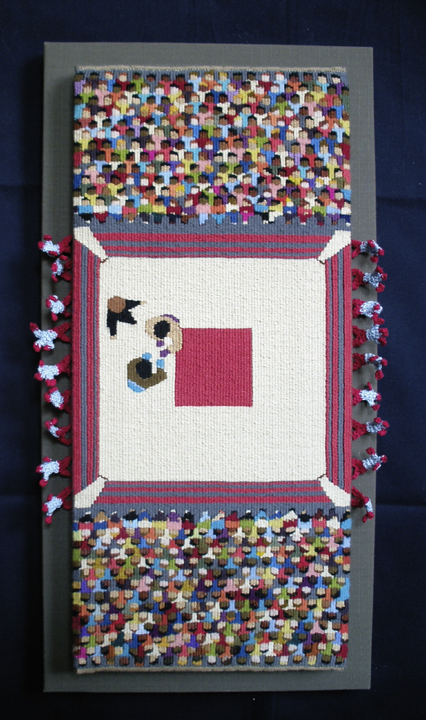
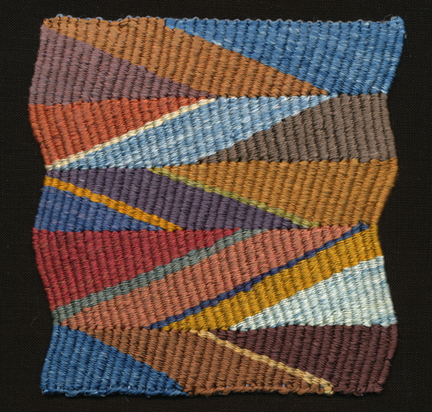
Mary Zicafoose: I am a rug-weaver-turned-tapestry-weaver who developed a fascination with ikat about 25 years ago. What began pretty innocently with a few scraps of a Hefty garbage bag knotted around a hank of yarn has evolved into complex tapestry imagery created by very intricate and layered ikat wrapping and tying techniques.  The process now demands months of wrapping, tying small pieces of japanese ikat tape — a brittle cellophane tape — around individual strands of mountains of silk and wool.

Wrapping ikat before dyeing. The weft section shown here will become approximately 3 inches of the finished piece.

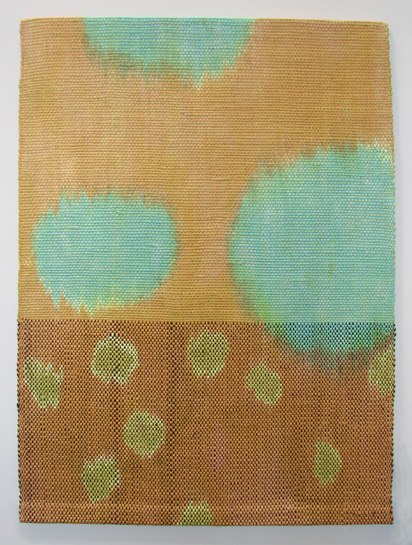
MZ: For the last 10 years I have produced ikat tapestries almost exclusively.  I’m currently working on a commission for a home that will require about 80,000 ikat ties.  When done tying I will dye the yarn and then untie all 80,000 design sections.  The weaving is almost a secondary process: literally just what holds all the ikat-dyed yarn together.  That said, the weaving is a monumental and time-consuming activity unto itself, since the pieces are large in scale. This particular tapestry will be a panel about 10’ x 10’, woven in silk, dyed the colors of the prairie sky before a thunderstorm.

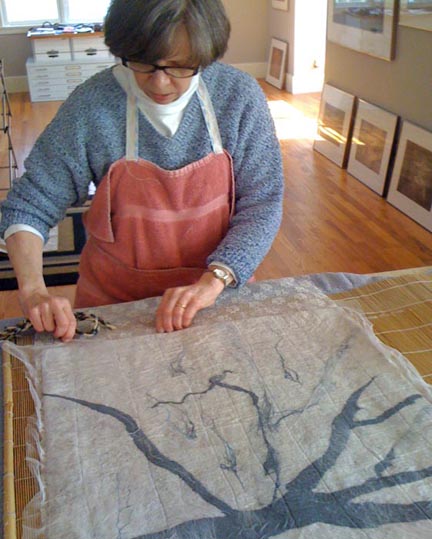
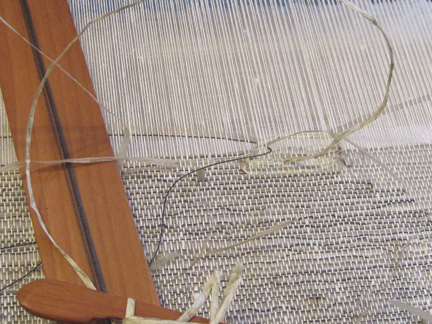
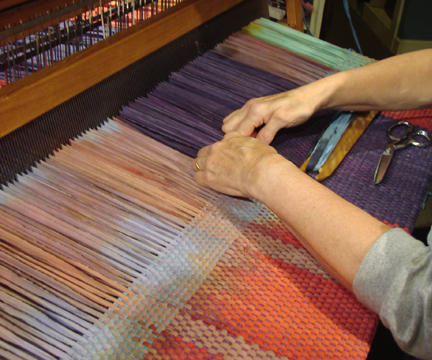
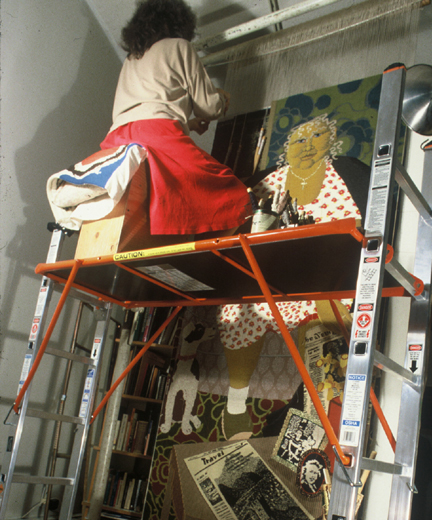
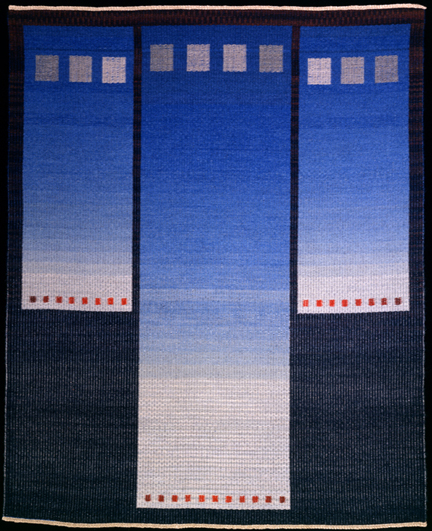
At the Loom: "Blueprint" in Process. All three sections of the triptych are woven simultaneously, row by row.

TSGNY: Was that first experiment with a shredded Hefty bag the result of an aha moment when you knew ikat was something you just had to explore?

MZ: Yes, of course.  I was working on a pretty involved classical tapestry piece, struggling to make it appear painterly and more spontaneous.  Just for the record, the words “spontaneous” and “weaving” are rarely used in the same sentence — they occupy two different universes, coming from completely different hemispheres of process.

I was very frustrated, feeling gridlocked and constrained by technique and the limitations of my equipment.  Then I flashed on a scrap of ikat cloth my aunt had given me as a child –a memento from some exotic junket she had been on — that I had held onto as precious.  I thought that’s where this needs to go: I need to embrace a textile process that allows some element of surprise or chance to occur.   This was in the 80s when there wasn’t much ikat going on anywhere. And so began the study.  I went to the Fairfield, Iowa, public library to get a book on ikat applications for tapestries and rugs, only to discover that no books on ikat process existed.  To date, almost 30 years later, there might possibly have been three books written on the subject.  I think I may have drawn the card to write the fourth.

"Ancient Text - Chain of Command" (diptych), 76" x 45", Weft-faced ikat tapestry.

TSGNY: What are the particular challenges of the ikat process?  How do you overcome them?

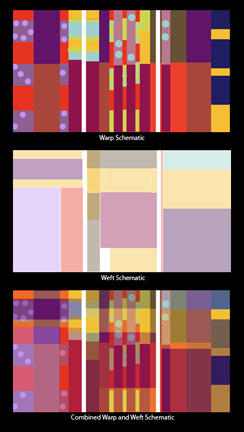
The Ikat cartoon: the design "exploded" in preparation for dyeing.

MZ: Ikat is a synonym for challenge.   A bolt of hand-dyed silk ikat fabric,  whether a beautiful 18th-century adras ikat robe or one of my ikat tapestries, is the composite visual solution to thousands of tiny complex problems. Ikat is based on math, geometry, dye chemistry, and the ability to think and design abstractly — expanding shapes and images at the ikat board to then severely compress them at the loom.  It also requires an abnormal otherworldly amount of patience with process–an actual fascination or addiction to process, I would say.

Unwrapping Ikat

MZ: I used to teach a lot of ikat until my process became so complex and layered that I could no longer explain it within a workshop context.  Also, very few weavers were interested enough in the visual product to invest and go where this takes you.   Weavers already have a time-consuming and totally demanding and economically unforgiving process–why take it to the 10th power?

Silk Ikat sorted and collated. Each ball of yarn is numbered with its place in the weaving sequence.

MZ: My undergraduate degree was in photography and my graduate work was in clay.  The sculptor in me is waiting for the day I’ve tied that last ikat wrap.

TSGNY: Clearly ikat has its rewards, because you haven’t tied your last tie yet. What does ikat enable you to do that you had not been able to do in other techniques?

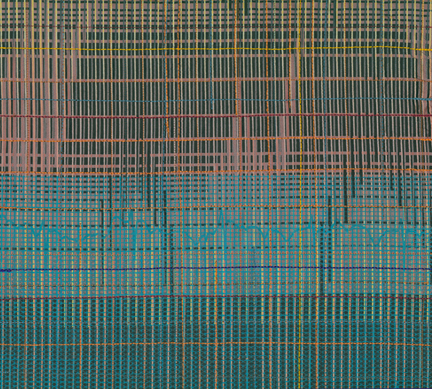
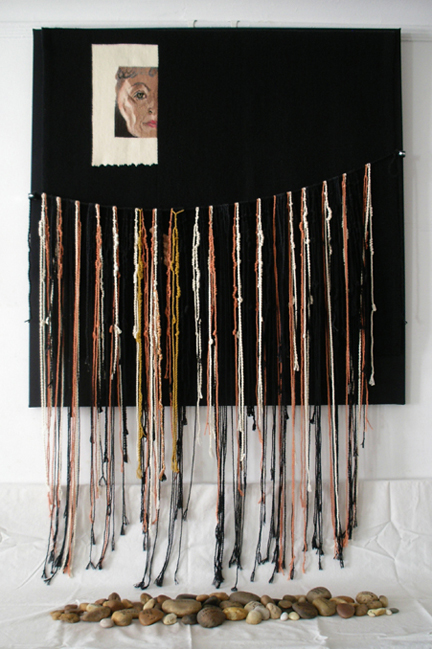
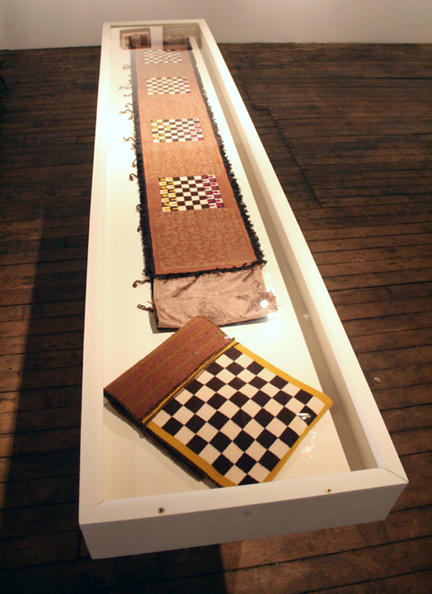
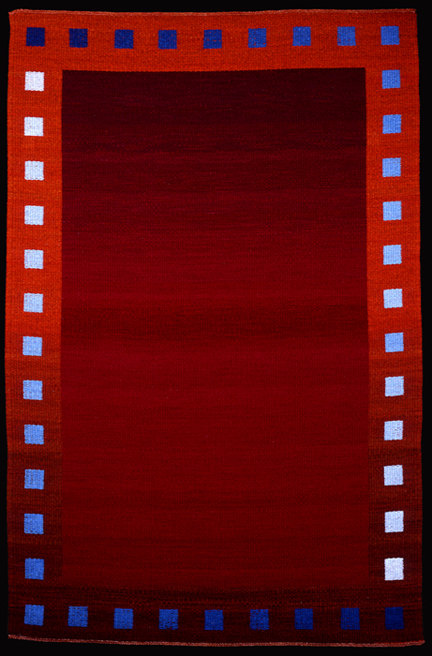
MZ: I always describe ikat yarns as being “coded.” Understanding the mechanics of this code has enabled me to create work that was never within my grasp, pieces that I would not have dared dream of creating. Recently I’ve been working almost exclusively in black and white, offset by sections of saturated color.

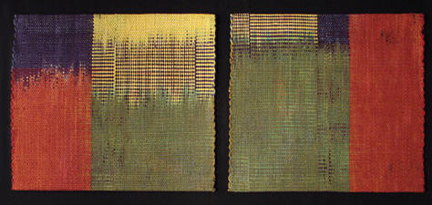
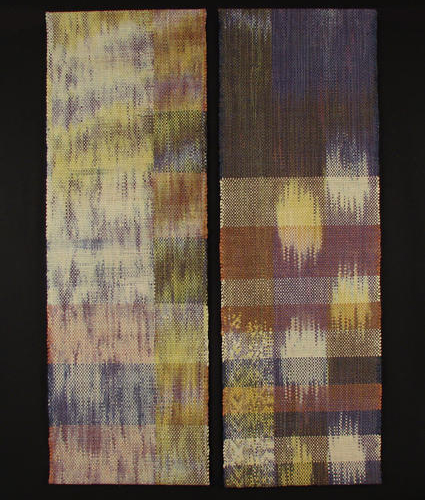
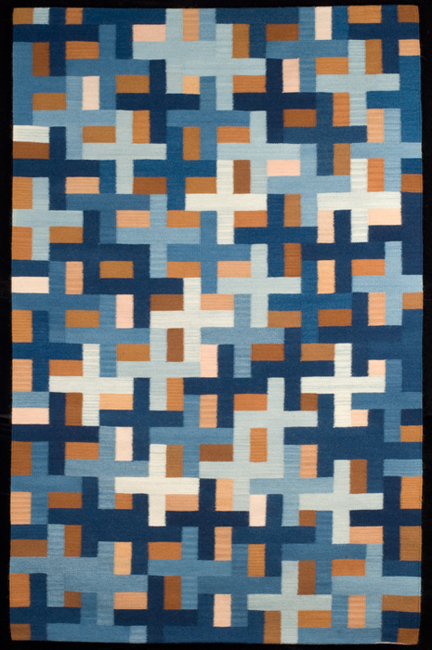
"Ancient Text - Indigo and Ochre" (diptych), 2007, 58" x 62", Weft-face Ikat Tapestry.

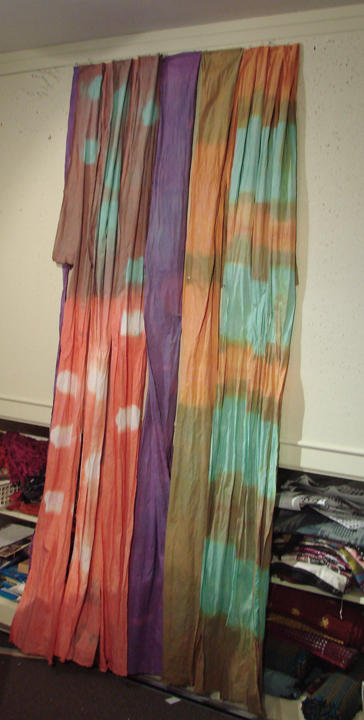
MZ: What is the visual difference?  Well, for one, complex ikat carries an energy, a frequency that makes it resonate differently than other textiles.  Perhaps it is the layers of overdyeing that produce more complicated and compelling saturations of color, perhaps the massive amount of human handling and touch that imbues it with so many layers of the “handmade,” but the element of magic is the serendipitous alchemy that happens when miles of wrapped ikat are submerged into vats of dye.  What sections resist the dye and where dye wicks up under the tape is random and uncharted and defies all plans and promises to clients.  The dye ebbs and flows and seeps and creates new and unexpected colors. The moment that the wrapped yarn slips into the colored waters of the dyepot is the precise moment the muse is invited to enter into the process. It’s as though another hand, another breath, has entered.

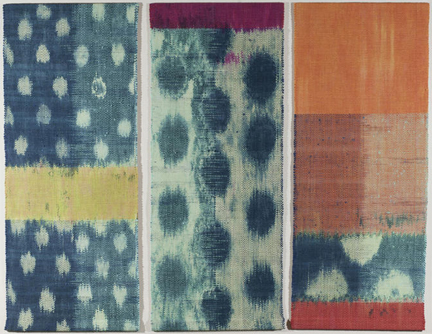
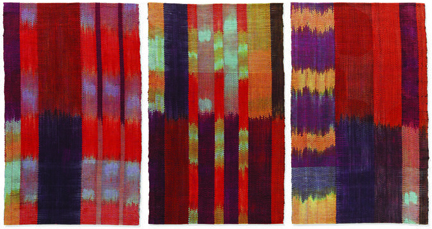
"Blueprint #7" (triptych), 2009, 84" x 88", Weft-face ikat, hand-dyed silk/bamboo on linen warp.

MZ: I am endlessly intrigued by this process and its applications.  I have had the great pleasure and opportunity to crisscross the globe traveling to ikat-producing countries and cultures.  I have wrapped ikat on remote islands, in Andean mountain villages, in factories, mud huts, and on horseback.

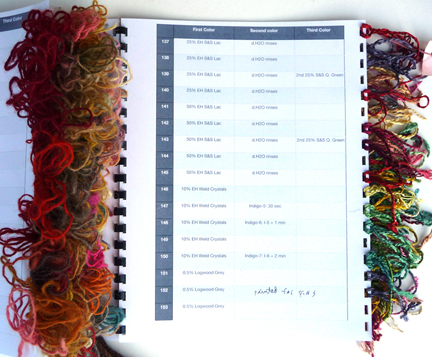
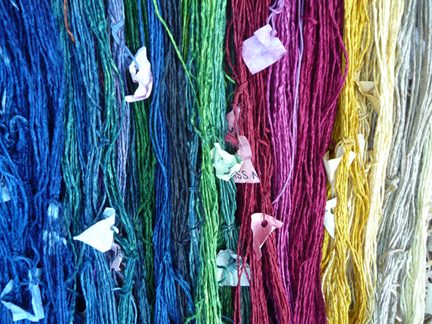
Matching colors. Zicafoose dyes all the yarns, referring to her library of more than 1,000 dye recipes.

TSGNY: Are there artists – in this medium or in others – you’ve come across in your travels who inspire you and who you’d like us to know about?

MZ: Besides my ethnic contemporaries a few artists in the UK are doing contemporary ikat.   I purposefully don’t follow their work.  Is that foolish?  It’s too easy to be influenced by your peers within your medium and field, actually to be deeply influenced by what they are doing. For me visual influences are as powerful as auditory–like when you hear a song you can’t get it out of your head.  It’s best if I just do my work and tell my story and not read too many other stories while I’m at it.  Yes, that may be foolish.  Ptolemy Mann is a UK ikat weaver of talent and note. American ikat weavers include Virginia Davis  and Polly Barton.

Early on in my rug-weaving days Mark Rothko was my big inspiration.  We all are familiar with how he treated large fields of color–how the edges collided and bled into each other–so very ikat.   When my husband Kirby and I traveled extensively in Peru and worked in Bolivia I fell under the spell of all things ethnic and ancient.  It took years behind the loom to weave South America out of my system.  When I finally emerged from that I fortunately had a strong sense of who I was as an artist and as a weaver and was very freed to be inspired by and to build my work on non-textile influences such as the visually powerful works and writings of Meinrad Craighead, the visionary Catholic nun;  Mary Oliver, the beloved Northeastern poet: the sculptor Martin Puryear, and the architect Phillip Johnson.  Sources of inspiration are an endless craving.

TSGNY: Thank you, Mary.

You can see more of Mary Zicafoose’s work here.

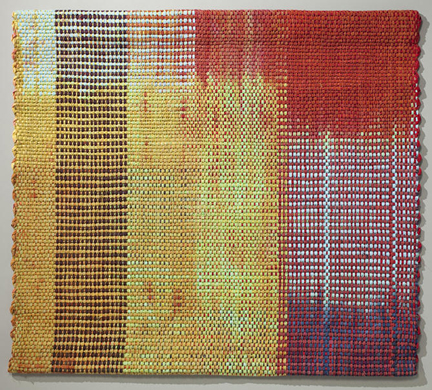
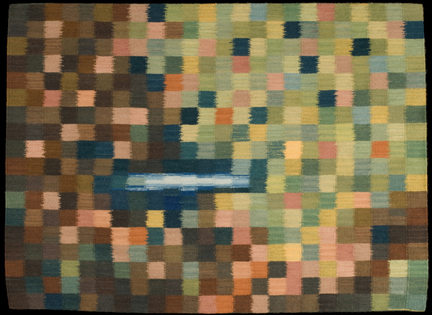
"Blueprint - Wine & Willow," (diptych), 2008, 48" x 76", Weft-face ikat.

Share

Katherine Knauer: Tampering with Tradition

TSGNY: How do you describe your art process?

Katherine Knauer: I’ve been a craftsperson my entire life and a quiltmaker since 1976.  In 1984 I discovered that I could print my own fabric designs with stencils and achieve a much more specific, personal result than with commercial fabrics.  I could design and print a group of fabrics depicting various aspects of one theme and piece those together for a quilt with a specific viewpoint.  I’ve been handprinting fabric since then. In 2009 I taught myself to use Photoshop in order to use an online fabric printing service called Spoonflower. Each quilt I make reflects a specific topic, usually taken from news headlines.  I’m currently working on a series of pieces about environmental concerns.

"Second Wind," from the Elements/Environment Series, 2010, 88” x 88”

KK: In “Second Wind,” all the surface fabrics that I digitally designed were printed using Spoonflower.  The theme of wind energy is illustrated in each print by images of wind turbines or dandelion seeds blowing in the wind or electrical devices such as lightbulbs, electric fans or power cords.  Wind is further represented by the color blue, and electricity by the color yellow.   And then extensive surface embroidery enlivens the rather flat surface.

Before the Elements/Environment series, I made quite a few quilts on the subject of war. I believe the unexpected juxtaposition of a traditional craft associated with comfort and warmth and disquieting imagery brings an extra layer of energy to my work.

"Conventional Forces," 1986, 84” x 84”

KK: In Conventional Forces, a “conventional”  (traditional) quilt pattern – a Log Cabin variation – has been adapted to accommodate textiles I designed and printed with images of “conventional” (non-nuclear) war.  I handprinted all the fabrics with stencils. I selected the piecing pattern to accommodate relatively large sections of printed fabrics.

"Conventional Forces" (detail), 1986, 84" x 84"

KK: The centerpiece of this quilt is a large image of a tank type used in Vietnam.  Other printed images used as repeat-pattern textile design include paratroopers, a concentration camp, soldiers in formation, falling bombs, rows of M-16 guns arranged in a herringbone pattern, jungle fighters, hand grenades, tanks, aircraft and wounded soldiers.  In two of the patterns, commercially printed fabrics are overprinted – a pattern of barbed wire over camouflage fabric, and burning buildings on another print.  The reverse side of this quilt is a stenciled hand-grenade design that took three days to print.

"Conventional Forces" (detail of reverse), 1986, 84” x 84”

TSGNY: With Photoshop in your design toolkit, and subjects like war and the environment, do traditional quilt patterns still have a role to play in your work?

KK: I love textiles and find traditional geometric quilt patterns irresistible.  The history of the patterns is fascinating – the titles reflect not only their appearance but what was on the maker’s mind or events of that era:  Whig’s Defeat, Drunkard’s Path,  LeMoyne Star,  Jacob’s Ladder, New York Beauty, etc.   When I use a traditional pattern in my work I am referring both to the historic pattern title and the possible meanings behind it. For example, “Streak O’ Lightning,” a zig-zag pattern, to me means something that happens in an instant and changes your life forever.  I’ve used it to represent sudden death, the destruction of war, and recently to represent electricity in a quilt about wind energy for the environmental series.

TSGNY: In spite of your serious subject matter, your patterns and images could be characterized as cartoony.  Is that intentional?

KK: It’s the way my style emerged from the get-go. I may have been influenced by the coloring books of my childhood.  I like areas of color to have distinct, crisp edges; I like heavy outlines.  I also love the look of woodblock prints and the silkscreened travel and propaganda posters from the 1920s and 1930s.  And stencil printing is particularly good for limited detail and large areas of a single color.

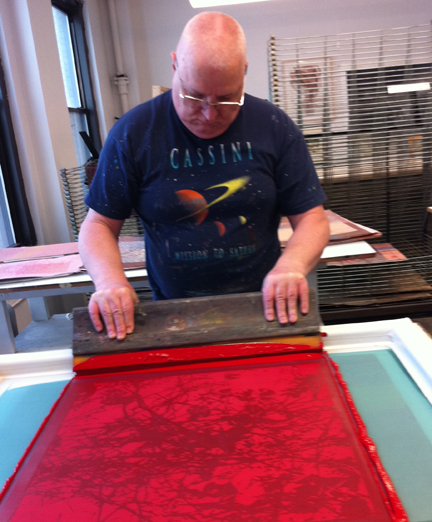
Stencil Printing

TSGNY: Do you get a different result from the hand-stencil process and from Spoonflower?

KK: Yes.  With hand stenciling I’m able to overprint commercial fabric and print over seams.  The color is deeper and more permanent.  I can have the resulting fabric the same day. And by using an airbrush or spray gun I can get an ombre effect or translucent effect and cover large areas. (My first air compressor sounded like a jet plane taking off and was very distracting.  I sold it and bought a “Super Silent” compressor when I was awarded a cash grant from the Empire State Crafts Alliance in 1988.)  In “Trouble in the Tropics,” for example, I achieved the translucent paint effects by lightly overspraying stencil prints in sections of a quilt that was made following our vacation to South America.  Each “postcard” monoprint depicts an unfortunate event that might befall a vacationer in the tropics.

"Trouble in the Tropics" (detail), 1990

KK: The benefits of using Spoonflower are unlimited yardage and the ease with which I can change size, proportion, color and other design elements.  I can preview my fabric in various repeat formats.  It’s easy to correct mistakes and to reorder.  I can have lots of little details and an unlimited color palette.  It’s also just fun to play around on the computer using Photoshop.

TSGNY: If you’ve tried other media, and are clearly not averse to modern technology, why do you stick with quilts?

KK: Quiltmaking allows me to create large, colorful pieces while working in a limited space. (I have a great studio now, but for years, the exigencies of family life in an apartment squeezed my quiltmaking into whatever compact space was available.)  I love being part of a craft tradition, and feel a great kinship with the lacemakers, seamstresses, weavers, knitters and quiltmakers of previous generations.  I also have a terrific support group among my quilting pals.

TSGNY: After the design excitement of the processes that go into the surface layer, how do you think about the part of the work that ties you most closely to that craft tradition: the quilting itself, the stitching that joins the three layers of the quilt together?

KK: Semper Tedium!  (An invented pseudo-Latin phrase meaning:  Long live the labor-intensive artistic process!)  The quilting is the payoff after making the top of the quilt.  The process is hypnotic, meditative and trance-inducing, especially when combined with a good audiobook.

TSGNY: A motto to live by! Finally, are there artists who influence you whose work you’d like us to know about?

KK: I love Mark Bradford‘s huge exuberant collages with permanent wave endpapers and paint. Philip Taaffe’s multi-layered, over-printed paintings are mysterious, hallucinatory and beautiful.  Nick Cave’s “soundsuits” are simultaneously playful and imbued with deep personal meaning.  Ditto for the stitched constructions of Charles LeDray, whose ethic of “work, work, work, work, work” strikes a chord with me. I visit museums several times a week and find living in NYC an endless banquet of visual inspiration.

TSGNY: Thank you, Katherine.

You can see more of Katherine’s work here; at the TSGNY exhibit “Crossing Lines”; and in  “Material Witnesses,” at The Art Quilt Gallery, 133 West 25th Street, NYC, November 15, 2011 – January 7, 2012.

Share

Carole P. Kunstadt: Transforming Text

TSGNY: How would you describe your current work?

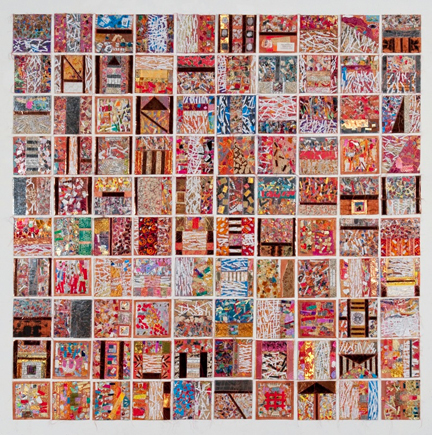
Carole P. Kunstadt: The Sacred Poems series, which I’ve been working on since 2006, has been an ongoing exploration generated solely by the materials: two editions of an antique book, dated 1844 and 1849. As an art student and in my first years as a freelance artist I was a calligrapher, and have always been fascinated by illuminations in manuscripts and books.  I purchased the first book in Vermont in 2000 from a used-book seller without any specific idea in mind. In 2006  it occurred to me to use the paper as the ground for a collage.  But to my surprise I was enticed and captivated by the  responsiveness of the paper: the inherently facile, tactile, tender yet strong pages. Soon I was transforming them in unexpected ways. The series has grown to 75 unique works celebrating life and the beauty that’s contained within the Psalmody.

TSGNY: What’s the range of the transformations you’ve subjected the paper to in this series?

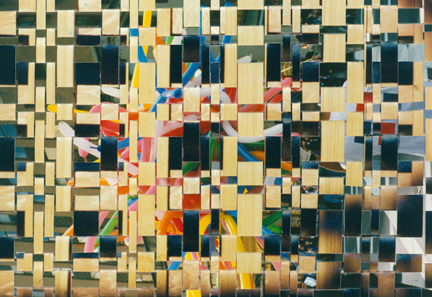
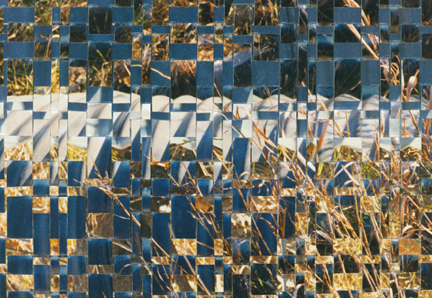
CPK: I’ve layered pages and machine-stitched through the lines of text, leaving a fringe of the threads; I wove strips cut from the pages, fascinated by the random patterns created by the letters. It had been over 25 years since I had been involved in tapestry weaving. The process was truly satisfying: to find previous skills resurfacing unexpectedly and from a different orientation.

"Sacred Poem LV," 2009, 5.5” x 5.625”, 24K gold leaf, paper: pages from Parish Psalmody dated 1844. Photo: Kevin Kunstadt

CPK: My lifelong fascination with texture came into play when I found that releasing the pages from the binding and cutting towards the crease created a ‘ruffle.’

"Sacred Poem XVI" (detail), 2006, 6” x 8” x 1.5”, thread, paper: pages from Parish Psalmody dated 1844. Photo: Kevin Kunstadt

CPK: I am in a constant state of discovery in this series as new ways of working with the paper evolve. I just completed a piece in which I gilded strips of pages with 24K gold leaf. The gilded strips were then woven, and hand-sewn/knotted with thread.

"SACRED POEM LXXV"(detail), 2011, 9.625” x 9.75” x .5”, 24K gold leaf, thread, paper: pages from Parish Psalmody dated 1849. Photo: Kevin Kunstadt

TSGNY: What was your work like before you embarked on the Sacred Poems?

CPK:  I had been working with handmade papers, layering with other ephemera and natural found objects, for over twenty years.  I was intrigued and inspired by found papers, and used old receipts, labels, currency and tickets that I collected in my travels, but also purchased antique postcards, ledgers, etc. for use in my collages. The series I was working on prior to this one, Markings, consisted of  6” x 6”  paintings in gouache that incorporated lines of script itemizing New Hampshire farm/estate sales, which I cut from a ledger from the 1860s.  I added lines of stitching by machine-sewing right through the paper. They were fluid and spontaneous – an immediate record of the day’s energy, incorporating the collage fragments from the past in an intimate and delicate manner. Towards the end of the series I worked graphite into them as well to accentuate the marks of script. Each one has its own presence but they also work well hung as groupings.

"Markings No.27 "(detail), 2004, 6” x 6”, gouache, collage and thread on paper. Photo: Kevin Kunstadt

TSGNY: It sounds like this new series puts many more demands on the paper than your older work. Is the fragility of 150-year-old paper an issue? Does it constrain your choices?

CPK: The pages from the book dated 1844 were amazingly flexible. The discoloration from aging is a honey color that provides warmth and depth. The paper wasn’t brittle – to the contrary, it was very forgiving. After a few years of focused work on the first book, I found myself running out of pages and tried to locate another book in similar condition. This has proven to be elusive . . . like the holy grail! I finally did buy an 1849 volume online and was surprised to find it so different in color and texture despite the few years’ difference. This book has led me to work a little differently. The pages are slightly larger, lighter in color, and less flexible. Inspired by working in the 9” x 9” x 3” format for the upcoming TSGNY exhibit, I ventured further into the realm of three-dimensional boxes. It has been a very liberating experience to work on an object as sculpture rather than a single surface.

"SACRED POEM LXIV," 2011, 4.75” x 4.75” x 2.25”, wire, 24K gold leaf on wooden egg & paper: pages from Parish Psalmody dated 1849. Photo: Kevin Kunstadt

TSGNY: Does the content of the manuscript pages affect your work? Is it different working on a secular text like the ledger and a sacred text like the Psalmody?

CPK: The handwritten script from the ledger I used in Markings provided curvilinear marks that captivated me with their fluid human strokes and implied personal history. The  fragmented words and letters suggested intriguing insights and anecdotes of another time. Combining a selected strip of paper from this recorded experience with a sewn and painted surface develops a new presence that builds on the remnants of previous generations. The persistence of time merges with the tenuous quality of life.

"Sacred Poem XLV" (detail)

CPK: The Sacred Poems’ use of a sacred text has been central to the methods of alteration of the papers’ nature. The repetitive actions of sewing, cutting, weaving, and knotting mirror the actions of reciting, singing, and reading: implying that the repetition of a task or ritual offers the possibility of transcending the mundane. Transformation and the possibility for revelation are primary elements of the work. This exploration led to a greater depth and connection to my creative core. The books have revealed themselves as vessels containing a rich source of history, and personal experiences which I am responding to intuitively.

The intended use, as well as the nature of a psalm as spiritual repository, both imply a tradition of careful devotion and pious reverence. The physical text evocatively and powerfully serves as a gateway to an experience of the sacred and the realization of the latent power of the written word. This process of interaction plays out visually in the piece, mimicking the internal experience. Through the individual evolution of each page, culminating in a transformation of the whole volume, the material and the conceptual interact delicately and suggestively with one another.

The casual purchase of a book ultimately changed my creative path.

TSGNY: I’m sure a lot of artists would recognize a similar moment of serendipity in their own lives. Finally, are there any artists whose work inspires you that would like us to know about?

CPK:  Zarina Hashmi‘s work has inspired me to explore the idea/intent as well as the materials in my work. Her ability to extract simplicity from complexity and present a vision of the world from her personal experience is fortifying and compelling. Her use of gold leaf – and Wolfgang Laib‘s — are thought-provoking and profound. He masterfully reorders and redefines materials and gets to their very essence. His work is unadorned, yet powerful in its simplicity.  Viewing his work is a sensory experience.

TSGNY: Thank you, Carole. You can see more of Carole’s work here, and in a solo exhibit at the Corridor Gallery at the Interchurch Center in New York City, Sept. 19 – Oct. 21, 2011.

Share

Jeanne Raffer Beck: Finding Ikigai in the Studio

TSGNY: You call yourself a “mixed-media textile artist.” What does that encompass?

Jeanne Raffer Beck:  I currently use a variety of materials and processes in my work. Earlier in my artistic life I was passionate about crossing disciplines to gather and learn techniques; I imagined that eventually one would stand out and I would build a body of work around it. Fiber, more than any other medium I explored, captured my imagination with its tactile sensibilities and its versatility. Eventually I realized that I wanted the techniques and processes to emerge from my ideas.  I now select particular techniques for various series because they seem to best serve the concept behind the work.

Before 2007 my works were layered, textural whole-cloth wall-hangings that I called “interior landscapes” — think dense machine and hand embroidery meets surface-design-on-silk and layered sheers.  In 2007, I started to envision a series of threadwork constructions incorporating printed cut silks to suggest pages of books.  In my vision for this series, each piece would increasingly deconstruct linear blocks of text until the letterforms themselves would dance in space, free from the confines of words or meanings.

"Pages 4," 2009, 33” x 96” Habotai silk, acrylic paint, dyes, cotton thread. Silkscreened, cut, mounted, stitched and hung on handcrafted stainless steel hanger.

TSGNY: So you needed to develop a new textile process to support the theme of deconstructed text?

JRB: Yes. A few years earlier at Penland, Hollie Heller had introduced me to the use of gel mediums on paper and silks, which allow paper to be used like cloth and cloth to be more paper-like. That workshop planted important seeds that emerged when I decided to move my work away from the wall with the Pages series.  I screen-printed silks with a variety of texts, both mechanical and handwritten, and then cut the screen-printed fabrics apart into tiny rectangles. I composed and sandwiched the rectangles on water-soluble fabrics and then stitched grids over the surface. Once I removed the water-soluble material, the pieces appeared to float and cast beautiful shadows on the walls. The interplay of positive and negative space in these works are continuing to inspire new directions and ideas, but as my ideas for these works evolve, so do the materials I use to execute them.

A long-time appreciation for Olga De Amaral‘s gold-leafed weavings and El Anatsui‘s recycled constructions led me to begin working with gold leaf. Currently I am working on a series of dimensional constructions titled “Writing in Air” and “Fluttering Pages,” inspired by books, handwriting and fragments of printed texts. These incorporate acrylic painted tissues, and gold leaf applied to spun polyester fabric, which I manipulate and combine to make into dimensional pieces mounted on fiberglass screening or gold-leafed, painted canvas.

"Writing in Air," 2011, 24” x 48” Spun polyester, tissue, gold leaf, stretched canvas frame. Painted, collaged, cut, manipulated and mounted on gold-leafed canvas.

JRB: These written language-inspired works consider the effects of time and the gradual disappearance of details of personal memories, both in aging and after an individual’s death. Fragments of documents, inscriptions or histories of individual lives are often all that survive over time.

Explorers have discovered exquisite, ancient cave paintings but know little to nothing about the individuals or cultures that created them. An ancient burial shroud covered with remnants of handwritten text was discovered in Egypt, but linguists can only partially translate the forgotten language in which it was written. Old letters, documents and journals reveal fragments of the lives of those who lived long ago; we are left to imagine the rest.

The bits and pieces that survive from individual and cultural histories have also led me to notice and appreciate the effects of contemporary aging and deterioration. I gather images of urban graffiti, decaying walls, rust and peeling paint. In addition, my interest in handwritten texts has grown. In an increasingly computer-driven age of text messaging, e-mail and social media, handwritten documents are virtually disappearing. Yet each person’s handwriting is as distinct and individualized as a fingerprint.

My personal desire is to translate the rhythms and energies of writing, dance, music and poetry to visual surfaces. I am passionate about immersing myself in studio work and enjoy the immensely fertile and creative waves of inspiration that it brings. Engaging in creative process is my way of making meaning in life. The Japanese have a word, ikigai, that does not have an exact English translation but roughly means, “a reason to wake up in the morning.”

"Crumpled Page," 2011, 48” x 48” Spun polyester, silk, gold leaf and stretched canvas frame. Cut silk letterforms applied to stitched polyester and mounted to gold-leafed, painted canvas.

TSGNY: That’s a wonderful concept. While we’re on the subject of motivation and inspiration, are there any living artists who inspire you whose work you’d like us to know about?

JRB: Two contemporary artists, Yves Leterme and Monica Dengo, who incorporate gestural calligraphy in their work. This loose, expressive form of writing is something I want to pursue further in my own practice. The energy in their mark-making is palpable and while Yves’ work is slightly more reminiscent of traditional calligraphy, both artists focus on the gestural energy of handwriting and the beauty of marks made by the human hand.

TSGNY: Thank you, Jeanne.

You can see more of Jeanne Raffer Beck’s work here and read her blog here.

"The Fluttering Pages of My Life 2; Remembered Address Numbers" (detail of a work in progress), 36” x 36” Fiberglass screen, polyester, gold leaf. Painted, screen-printed, cut and stitched.


Share

Bonnie C. Epstein: Embroidering the Story

"Safety Net Fragment" (detail) 8 3/4" x 8 3/4" Newspaper, joss paper, cotton interfacing, thread. Hand and machine stitching. Photo: D. James Dee

TSGNY: How do you describe your work?

Bonnie Epstein: I am a hand-embroiderer.

TSGNY: You embroider, but not on fabric . . . .

BE: No. I construct lace-like structures made of paper intercepted on its way to the recycling bin – - maps of all kinds, ledger sheets, catalogues, fliers, newspapers, magazines, ads, envelopes, almost anything except scented papers. I harvest clippings, coat them with matte medium, machine stitch them to cotton interfacing, then use basic hand-embroidery stitches to connect and embellish the paper elements.

TSGNY: What kind of artwork were you doing before you developed this method of combining found paper with embroidery?

BE: I would say I first became “an artist” in the technicolor paradise of my grandmother’s yarn store.  During sweltering pre-Salk vaccine summers in the Catskill Mountains resort village where I grew up, I begged to be allowed to work in the store rather than stay at home to play in the backyard. I fell in love with threads, yarns, and texture; and discovered the transformative powers of color and pattern.

BE: I was also taught that every woman had to be able to earn a living, that an artist could not earn a living, and that a teacher would always be able to support herself.  So after college I was a teacher. I lived abroad, moved to Manhattan, changed professions, married, lived abroad again, and returned to Manhattan in 1978.  Walking along Broadway with my children, I discovered the Thread Company and Lisbeth Perrone’s needlepainting classes. I have been an embroiderer ever since.

For years I designed and embroidered functional items – - one-of-a-kind ceremonial cloths sold at museum shops, a succession of accessories sold at boutiques, and numerous embroidery samples and prototypes for the garment industry.  Although I read  Fiberarts  and visited fiber exhibitions, my work had to conform to color and trend forecasts.  Membership in TSGNY offered options and encouragement.  In 1998 I covered my 9X9X3 box with photographs embellished with embroidery.  It was my first experiment with embroidery on paper.

"Window Box" (detail) 9" x 9" x 3 Wooden box, photos, fabric, thread. Photography, hand stitching. Photo: D. James Dee

TSGNY: When did the found paper become central to your work?

BE: After the 9x9x3 show, TSGNY members Ann Kronenberg, Colette Wolff and Joan Pao goaded me to continue exploring the possibilities of stitching on paper.  Their incredible friendships, insightful critiques and patient mentoring are invaluable gifts. In 2003, frustrated by the growing piles of paper awaiting recycling, and provoked by increasingly angry red, orange, and yellow terror warnings printed on many of those papers, I challenged myself to make good use of the mess.  I wanted to maintain the integrity of the papers rather than printing or copying their texts and images on fabric, but I had to find a way to strengthen and preserve them. Months of experimentation led to the techniques that I continue to use.

TSGNY: So your paper isn’t fragile?

BE: Paper coated with matte medium then machine stitched to cotton interfacing is parchment-like: tough, yet wonderfully pliable. It is a perfect base for embroidery.

TSGNY: How do you decide which of the incoming paper to incorporate in your work?

BE: I work at home; some days the papers that arrive are so compelling that they call me to deal with them at once. Often their potential is obvious, but it takes me a while to make use of them.  Five years’ worth of charts and graphs from the financial pages are currently being stitched into a series of “safety nets.” I am also exploring the possibilities of envelopes.

"Mail Box" (detail) 6 1/2" x 6 1/2" Paper envelopes, cotton interfacing, thread. Hand and machine stitching. Photo: D. James Dee

TSGNY: How has this choice of recycled material affected your artwork?
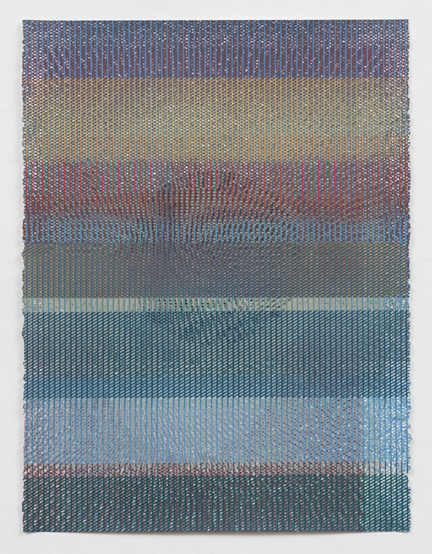
BE: Needless to say, much of my work is infused with text. I use it as pattern, and as visual texture. Frequently the text determines the path of my work. A fully text-based work in progress is “No End in Sight,” a documentary series composed of “Names of the Dead”  lists clipped from our newspaper almost daily since the autumn of 2005.  These lists include names, ages, hometowns, and military units of American service members killed at war in Afghanistan and Iraq.  “No End In Sight” is a series of annual documents of deaths.  So far I’ve completed two years of the series:  “Autumn 2005 – 8/ 8/ 2006,” and “8/ 9/ 2007 – 8/10/ 2008.”   I’m just beginning “8/11/ 2008 -  8/9/2009.” There were 30 names on the list I clipped yesterday and sadly, there is no end in sight. 

"No End in Sight 8/2006- 8/2007" (detail) Approx. 68" X 45" Newspaper, cotton interfacing, thread. Hand and machine stitching. Photo: D. James Dee

BE: Selectively harvested materials enable me to explore issues and events, capture a mood, comment quietly, and hopefully stimulate discussion.

The treated paper also enables me to construct deceptively fragile-looking structures. When suspended, their flickering shadows playfully deflect evil and fear. I  think of my first pieces as talismanic and call them Security Blankets. To increase the potential for shadows, I stitched bits of metal hardware cloth mesh (aka Rat Wire) among the paper squares.  I continue to construct unique lace-like paper structures, happily mining the seemingly endless potential of the daily paper crop.  Each harvest sparks fresh ideas for new work.

"Security Blanket" (detail) 31" x 26 1/2" Paper, cotton interfacing, hardware cloth, thread. Hand and machine stitching. Photo: D. James Dee

TSGNY: Finally, is there any living artist whose work inspires you who you’d like us to know about?

BE: Since I began exploring the possibilities of recycled paper, I have become increasingly interested in the work of artists whose innovative use of recycled materials enables them to explore a broad range of issues.  Several years ago I discovered the fascinating installations of Guerra de la Paz, a collaborative of two Cuban-born artists working in Miami.  The pair builds lush, seductive, politically resonant environments of recycled textiles. Used as construction materials, these textiles remain secondary to the message of the work.  The team’s skillful twisting and knotting so totally transforms their materials that it is shocking to suddenly realize that the foliage above your head is composed of masses of green patterned, solid, and printed sweaters, shirts, dresses and pants.

TSGNY: Thank you, Bonnie.

"No End in Sight" (Autumn 2005 - 8/ 8/ 2006 and 8/ 9/ 2007 - 8/10/ 2008) Each approx. 68" X 45" Newspaper, cotton interfacing, thread. Hand and machine stitching. Photo: D. James Dee

Share

Lorrie Fredette: 110 Elements A Day

Lorrie Fredette lying under a section of her installation, The Great Silence (suspended just 30 inches above the floor).

TSGNY: Tell us about your process and what drew you to it.

Lorrie Fredette: I paint with molten beeswax mixed with tree resin (encaustic medium) on unbleached cotton muslin that has been fitted and hand-sewn to a wire armature. While I have worked in textiles over the years, I had not previously combined them with the encaustic medium.  I began working with encaustic in 1999 but didn’t “commit” to it as a formal material in my work until 2005. The two primary materials (beeswax and unbleached cotton muslin) offer me several components that are vital to my work: translucency, controlled pigmentation, a lightweight finished object, and the ability to create a series with many minute variations. I also respond to the historical and contemporary associations of the materials.

TSGNY: Can you elaborate on some of those associations?

LF: I often draw on medical and environmental stories as inspirations for my work. Wax — in particular, paraffin — was historically used to encapsulate biological specimens.  For example, in the U.S. during the outbreak of the Spanish Flu of 1918, samples were taken from each person who passed away from influenza.  Those samples have been (and still are) stored in several U.S. federal labs. Muslin is used to make sewing patterns for garments and upholstery.  In theater, it is the ground to paint backgrounds for sets.  It is used in the culinary field as a filter for wine, cheese and to separate out solids from liquids like in processing apples. In the medical field muslin gauze is used in neurosurgery to wrap vessels at risk for bleeding.

A half-sewn element. Unbleached cotton muslin whipstitched over a handmade and soldered armature.

TSGNY: Encaustic is usually a 2D medium. Are there any challenges to using it in 3D work?
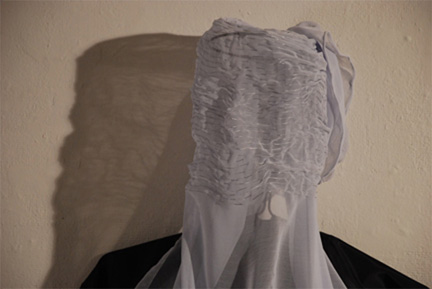
LF: I work just outside the limitations of my materials.  It is recommended that wax be applied to a rigid surface for 2D work, since bounce can cause cracking and/or detachment from the substructure.  I create 3D elements and work on hollow forms. I think the very taut substructure and the multiple layers of paint decrease the risk of cracking.  Fusing between painted layers (heating each layer so it molecularly attaches to the layer below it) dramatically reduces the possibility of fracture.  Other materials would be less expensive (I used more than 275 pounds of wax for The Great Silence) and take less time to make.  But for now, these materials support my intent.

The foreground shows several painted elements that have been strung for installing. The middle ground shows several sewn and one half-sewn element.

TSGNY: How did you develop the process of creating the multiple elements that go into your pieces?
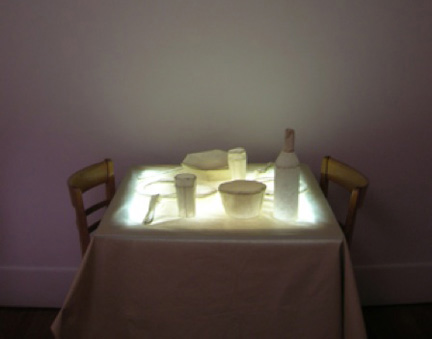
LF: I realized that in order to create the serial elements, I needed to be able to construct my own armatures and quickly determined that I needed to learn to solder.   This was before iChat, SKYPE and Facetime came into existence; I was taught how to solder by TSGNY member Biba Schutz via  telephone.  After making the armatures, I pin and sew the muslin to them in a manner similar to traditional handmade lampshades. Then I melt my wax in a 16-quart roasting pan, allowing me to paint the seven coats per pod as well as paint 110 elements in a day.

The work table covered with 55 painted elements.

TSGNY: What was your work like before you made the commitment to these materials?
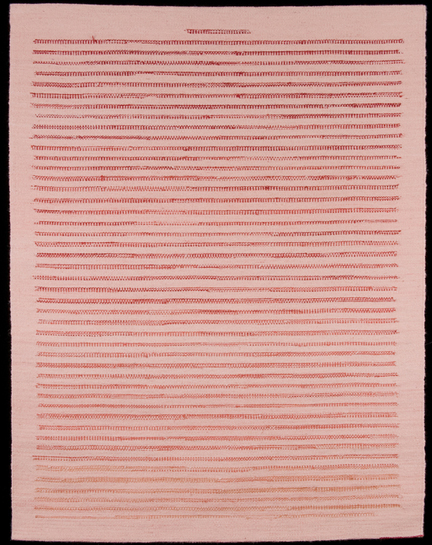
LF: Before I began working with encaustic medium and returned to working with textiles, I was creating abstract figurative drawings and sculpture.  My preferred sculptural materials were combinations of wood, metal, fiberglass and plastics.  These pieces were humble in size, less than 2 feet, and pedestal bound.

TSGNY: So engaging with the new medium allowed you to change scale, and fill much larger spaces?

LF: I wouldn’t say my work changed as a result of these materials.  I think it’s more accurate to say my work changed because I wanted to be a different kind of artist, and the choice of materials grew out of that. My concept is about distortion and that concept is supported through seriality and size.  Each individual element is slightly different because of its “handmadeness.”  I believe this variation is similar to how a story is told.  Each version is slightly different from the last told by the teller.  Group those individual portrayals together and you begin to see the differences, once you get past the cacophony of the whole experience.  I make multiples not only to create site-responsive installations to fill a space but again, to alter a rendition.

Lorrie Fredette, The Great Silence. Bank of America/Hunter Gallery at the Cape Cod Museum of Art. 6 feet 6 inches H x 36 feet 10 inches W x 5 feet 8 inches D suspended 8 feet 6 inches from the floor. Beeswax, tree resin, muslin, brass, steel, nylon line. © 2011

TSGNY: Finally, is there any artist working today who inspires you whose work you’d like us to know about?

LF: One of many contemporary artists I admire is Laura Splan. TSGNY members might recall her work at the Museum of Art and Design’s Pricked: Extreme Embroidery.

TSGNY: Thank you, Lorrie.

You can see more of Lorrie Fredette’s work here and in the wonderful book Encaustic with a Textile Sensibility.


Share

Fiber: A Love Story

Our diverse membership is united by the fact that at some point in our art practice, each of us fell in love (perhaps even became obsessed) with a particular fiber technique or process or material. In the coming months, we’ll be asking our members and our guest speakers to tell us their stories of love and obsession . . . . Stay tuned.

Share